
Description
NAD+ Nasal Spray — Research Formulation and Technical Overview
Nicotinamide adenine dinucleotide (NAD+) has become an important focus of biochemical research because of its established roles in cellular energy metabolism, redox reactions and NAD+-dependent enzyme systems.
While much of the scientific discussion centres on the molecule itself, the formulation and presentation of NAD+ are equally important considerations when developing research products.
At NAD-GO, we specialise in high-purity NAD+ research materials, including pre-filled dispensing systems and emerging formulation technologies.
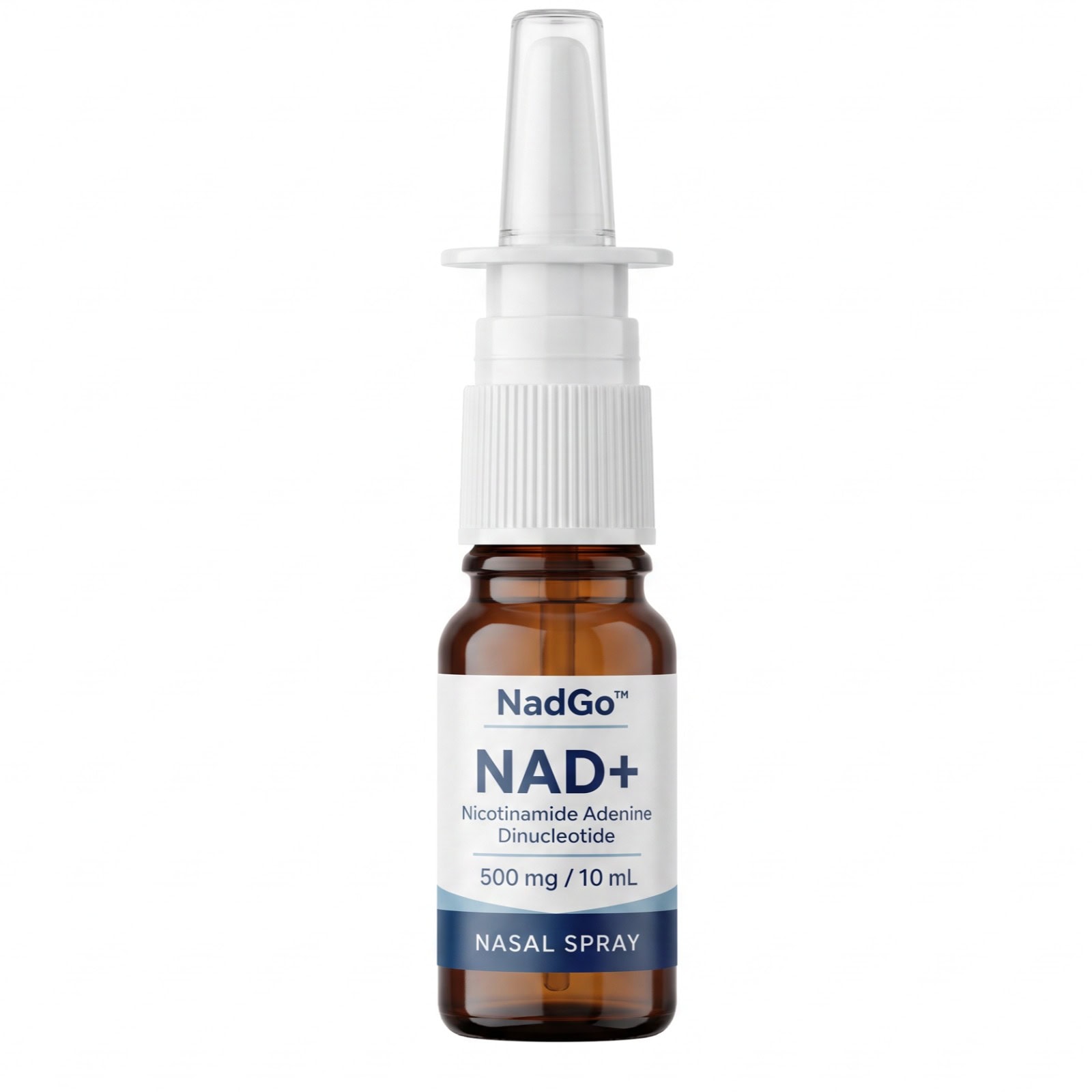
Our NAD+ nasal spray is developed as a separate research format, combining a liquid NAD+ preparation with nasal spray packaging.
Unlike our existing NAD+ research pens, which use a cartridge and mechanical click-dial system, the nasal spray format incorporates a spray dispensing mechanism.
This difference introduces specific considerations relating to formulation chemistry, spray-device performance, stability and analytical verification.
A Research Formulation Built Around NAD+ Chemistry
NAD+ is the oxidised form of nicotinamide adenine dinucleotide, an essential coenzyme found throughout living cells.
Its best-established functions include participation in oxidation-reduction reactions, where NAD+ accepts electrons to form NADH.
NAD+ also serves as a substrate for enzyme families such as sirtuins, poly(ADP-ribose) polymerases and CD38.
These enzymes are involved in diverse aspects of cellular signalling, metabolism and maintenance.
However, the biological importance of intracellular NAD+ is separate from determining the behaviour of NAD+ within a particular externally supplied formulation.
For that reason, our nasal spray development approach places emphasis on the physical and chemical characteristics of the product rather than unsupported claims about absorption or therapeutic effects.
Readers interested in the underlying science can explore our NAD+ biological research overview.
Understanding the Nasal Spray Formulation
Producing a liquid formulation suitable for use with a nasal spray device involves several considerations beyond the chemical purity of the starting NAD+ material.
These include the concentration of the compound, the properties of the liquid medium, the compatibility of the formulation with the container and the consistency of the dispensing system.
A critical distinction is that chemical purity, finished-formulation concentration and spray-device performance are separate measurable characteristics.
A high-purity NAD+ starting material does not automatically establish the concentration or stability of the finished preparation.
Similarly, a spray device capable of delivering a consistent volume does not independently establish the chemical composition of the liquid being dispensed.
Each characteristic needs to be evaluated through appropriate technical specifications and testing.
Formulation Concentration
The concentration of a liquid research product describes the amount of NAD+ present within a specified volume.
It is usually expressed in milligrams per millilitre (mg/ml).
For example, concentration can be calculated by dividing the total mass of NAD+ by the total solution volume.
However, a calculated nominal concentration should be distinguished from a laboratory assay of the finished solution.
pH and Buffer Chemistry
The stability of NAD+ in solution can be influenced by pH, temperature and formulation composition.
Buffer systems may be used to maintain a more controlled chemical environment.
The selection of a suitable buffer requires consideration of the specific compound, formulation objectives and intended analytical characteristics.
A formulation should not automatically be assumed stable simply because it contains a buffering component.
Stability is a property that needs to be established for the complete finished formulation.
Solution Consistency
For liquid research materials, maintaining consistent composition is important.
Formulation development may involve assessing chemical concentration, appearance, physical stability and other relevant properties over time.
These considerations become especially important when the liquid is paired with a mechanical dispensing system.
The formulation and device must be assessed together rather than treated as independent finished products.
How Nasal Spray Dispensing Differs From a Pen
The main mechanical difference between a nasal spray and a pre-filled NAD+ pen is the way liquid is displaced from the container.
Our established NAD+ pens use an adjustable dispensing mechanism integrated into a cartridge.
A nasal spray device instead uses a spray actuator designed to expel liquid through a nozzle.
For a metered spray system, important engineering characteristics may include:
- Liquid output per actuation
- Consistency of delivered spray volume
- Spray pattern and plume geometry
- Droplet-size distribution
- Compatibility between the formulation and device components
- Performance throughout the intended usable life of the container
These characteristics are widely recognised in nasal spray development.
However, they should not be confused with evidence of biological absorption.
A spray device producing a repeatable output does not automatically establish how much intact NAD+ passes through a biological membrane.
At NAD-GO, we distinguish between the physical performance of the dispensing format and the separate scientific questions surrounding intranasal NAD+ research.
NAD+ Nasal Spray and Bioavailability Research
Intranasal delivery is an established area of pharmaceutical and formulation research.
Different compounds can behave very differently when introduced into the nasal environment.
Their absorption characteristics may depend on molecular structure, solubility, charge, formulation composition and biological barriers.
NAD+ is a relatively large, highly polar coenzyme, making the behaviour of externally supplied NAD+ an important subject for direct investigation.
It would be scientifically inappropriate to assume that because some compounds can be absorbed through the nasal mucosa, an NAD+ formulation will demonstrate the same behaviour.
Similarly, research involving oral NAD+ precursors such as NMN or NR does not establish the absorption characteristics of intranasal NAD+.
Human pharmacokinetic evidence for this particular route remains limited, and reliable quantitative claims about systemic bioavailability or direct brain delivery cannot currently be made for the NAD-GO formulation.
Our nasal spray is therefore positioned as a research product, not as a clinically validated alternative to other forms of NAD+ administration.
Analytical Quality and Independent Testing
At NAD-GO, our wider product-quality approach incorporates defined material specifications, batch documentation and access to independent analytical testing.
We work with a specialist laboratory in the United Kingdom with analytical capabilities that include High-Performance Liquid Chromatography (HPLC) and Mass Spectrometry (MS).
Our team has visited the laboratory and reviewed its facilities and testing capabilities, giving us direct familiarity with the analytical environment supporting our broader research-material testing arrangements.
These techniques serve different purposes.
HPLC analysis can help assess chemical purity, composition and specified impurities when used with a suitable validated method.
Mass spectrometry can provide information supporting the identification of the intended compound.
Quantitative assay methods can establish compound concentration or content in a particular tested sample.
The actual testing scope for the finished nasal spray will need to be established by its product-specific documentation.
A purity result for the NAD+ starting material should not be presented as proof of finished-spray concentration, dispensing accuracy or stability.
This distinction is central to how we approach transparent research-product specifications.
Manufacturing Controls and Traceability
NAD-GO operates within a structured quality framework incorporating GMP-aligned procedures and oversight of sourcing, documentation, manufacturing partners, handling and distribution.
Our approach includes defined responsibilities, batch traceability and appropriate quality-control procedures.
The term GMP-aligned describes the principles incorporated into our quality system. It does not mean that NAD-GO itself holds formal GMP manufacturing certification.
Further information is available in our certifications and compliance framework.
For a research formulation such as NAD+ nasal spray, traceability is particularly relevant because chemical quality and device characteristics must both be considered.
Each supported product claim should be associated with the appropriate specification or test evidence.
Understanding Storage and Stability
NAD+ solution stability depends on factors including temperature, pH, solvent composition and storage duration.
The storage characteristics of one NAD+ product cannot automatically be applied to a different formulation.
For example, NAD-GO’s existing pre-filled pens use a stabilised liquid formulation designed for storage under the conditions specified for that product.
The nasal spray is a separate formulation and packaging system.
Its appropriate storage temperature, shelf life and any requirements following opening must be based on its own supporting evidence.
Until those specifications are finalised, the product should not be described as indefinitely stable, universally suitable for room-temperature storage or equivalent in stability to our existing pen range.
The final storage instructions will be supplied with the product when its specifications are confirmed.
NAD+ Nasal Spray vs NAD+ Research Pen
NAD-GO’s current product development encompasses different approaches to containing and dispensing NAD+ research formulations.
| Feature | NAD+ Nasal Spray | NAD+ Research Pen |
|---|---|---|
| Product status | Available | Available |
| Formulation format | Liquid research formulation | Pre-filled liquid formulation |
| Container | Nasal spray bottle | Integrated pen cartridge |
| Dispensing mechanism | Spray actuator | Mechanical click-dial |
| Available strengths | To be confirmed | 200mg, 500mg, 1000mg |
| Storage requirements | Product-specific, to be confirmed | Published pen specifications |
| Intended purpose | Scientific research | Scientific research |
The NAD+ internasal vs pen comparison concerns product presentation and engineering characteristics.
It does not establish that either format offers superior biological delivery or clinical effects.
Researchers seeking an available formulation can explore our NAD+ pen collection.
Exploring Alternative NAD+ Formulation Technologies
In addition to our pre-filled pen range, NAD-GO hass developed a dual-chamber auto-mixing NAD+ pen.
This forthcoming technology is designed to store lyophilised NAD+ separately from its liquid diluent until the mixing stage.
The concept illustrates another formulation challenge: balancing chemical stability, packaging design and controlled preparation.
The dual-chamber product has different engineering objectives from the nasal spray.
Together, these projects reflect NAD-GO’s broader interest in specialised research formulation technologies.
About NAD-GO
NAD-GO is a UK-based research-product supplier focused on NAD+ and related compounds, formulation technologies and documented product quality.
Our approach combines defined material specifications, GMP-aligned processes, independent analytical relationships and a commitment to transparent research information.
Learn more about our company and development approach on the About NAD-GO page.
We also publish technical and scientific information through the NAD-GO Research Journal.

Reviews
There are no reviews yet.