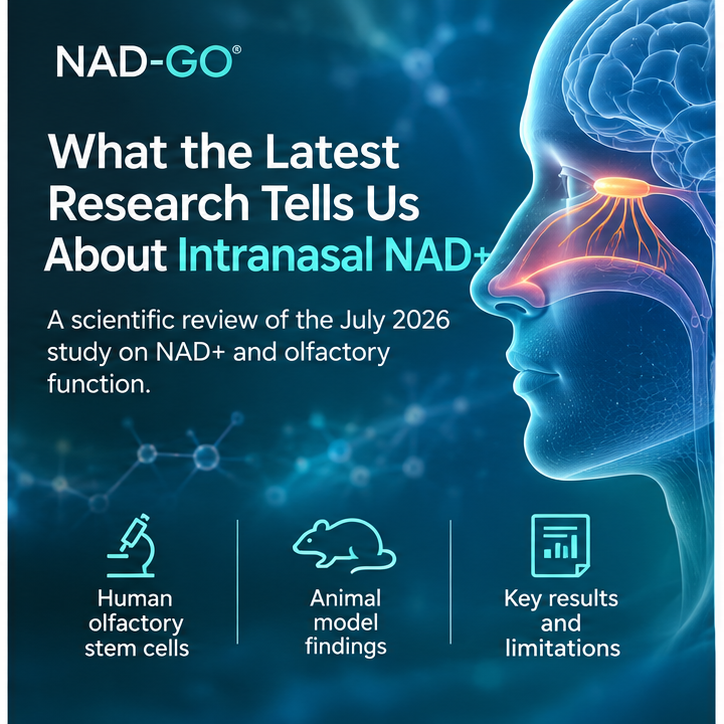
In July 2026, researchers published a study examining intranasal nicotinamide adenine dinucleotide (NAD+) in an experimental model of olfactory dysfunction.
The paper is interesting for a reason that goes beyond the usual discussion of NAD+ and cellular energy: it investigated the compound in the context of nasal tissue and olfactory biology, rather than relying entirely on findings from other delivery routes.
For a company such as NAD-GO, which supplies an NAD+ nasal spray research formulation, this makes the study particularly relevant.
It is also a useful example of how easily promising laboratory findings can be overstated.
The research offers evidence of biological activity under specific experimental conditions. It does not establish that commercially available NAD+ nasal sprays improve human health, deliver intact NAD+ to the brain or produce predictable systemic absorption.
Those distinctions deserve closer examination.
What the Researchers Actually Investigated
The paper, published in Experimental & Molecular Medicine, was titled Therapeutic Effect of Intranasal Nicotinamide Adenine Dinucleotide in the Restoration of Olfactory Dysfunction.
The authors investigated NAD+ in two experimental settings.
The first used cultured human olfactory stem cells.
The second involved mice in which olfactory dysfunction had been induced using zinc sulphate.
These are very different research models.
Cultured cells allow investigators to examine specific cellular responses under controlled laboratory conditions.
An animal model provides an opportunity to study tissue changes and physiological responses within a living organism.
Neither is equivalent to a human clinical trial.
The human olfactory stem-cell experiments
The researchers treated cultured human olfactory stem cells with NAD and evaluated changes associated with their development into olfactory sensory neurons.
Their methods included immunofluorescence staining, polymerase chain reaction and western blot analysis.
These techniques provide different forms of information.
Immunofluorescence can identify particular proteins within cells.
PCR-based methods can assess selected gene-expression changes.
Western blotting can provide evidence concerning protein abundance.
The researchers reported changes in markers associated with olfactory neuronal differentiation, including SOX2, nestin, Tuj1 and OMP, alongside several neuronal differentiation-related genes.
This suggests that NAD exposure influenced the behaviour of the cultured cells under the experimental conditions.
It does not demonstrate that the same response occurs in the nasal tissues of a person using an NAD+ spray.
The mouse experiments
The second component involved mice with zinc sulphate-induced anosmia.
Anosmia refers to loss of the sense of smell.
The researchers compared outcomes involving intranasal NAD, a dexamethasone comparison group and control conditions.
They evaluated olfactory behaviour, tissue morphology and molecular changes.
An important feature of the study was its use of more than one measurement type.
The researchers did not rely solely on a single behavioural outcome.
They also investigated tissue-level and gene-expression changes associated with the observed responses.
What Did the Study Find?
The researchers reported improvements in olfactory outcomes in the NAD-treated mice.
Their behavioural findings showed that olfactory function improved by day 28 compared with the relevant experimental groups.
The study also reported changes in the olfactory epithelium consistent with tissue repair.
Using RNA sequencing, the researchers identified a group of 113 differentially expressed genes associated with the relevant experimental comparison.
Within that analysis, 25 genes associated with modulation of chemical synaptic transmission were upregulated in the NAD group.
Further analysis identified six neuronal marker genes of interest:
- ABHD2
- DLGAP2
- FOXO3
- HIPK2
- KCNMA1
- PCDH17
The researchers also examined selected protein-expression changes and used in situ hybridisation to validate particular molecular findings in tissue.
This combination of behavioural, cellular and molecular measurements makes the paper more informative than a study reporting only one biological marker.
It also creates several questions that future research can investigate more precisely.
What the Evidence Actually Establishes
It is useful to separate the observations from the conclusions that cannot yet be drawn.
| Research question | What this study contributes |
|---|---|
| Can NAD exposure influence cultured human olfactory stem cells? | Evidence of changes in differentiation-related markers |
| Can intranasal NAD affect outcomes in a mouse model of olfactory injury? | Reported behavioural and tissue-level improvements |
| Does this establish efficacy in people with smell loss? | No human clinical efficacy trial was conducted |
| Does it measure systemic NAD+ bioavailability in humans? | No |
| Does it establish direct delivery of intact NAD+ to the human brain? | No |
| Does it validate NAD-GO’s commercial nasal spray? | No; a separate formulation was investigated |
This distinction is central to responsible interpretation of the paper.
The findings provide a reason for further investigation. They are not evidence that every NAD+ nasal spray formulation will produce the same outcomes.
Why the Study Is Not a Human Bioavailability Trial
One of the most common misunderstandings in discussions of nasal delivery is the assumption that a biological response proves a particular absorption pathway.
These are different questions.
A substance administered through the nasal cavity may interact with local tissues. A biological response in those tissues does not necessarily establish systemic exposure.
Likewise, the observation of an effect in an animal model does not reveal the percentage of the administered compound reaching human circulation.
For NAD+, the challenge is particularly interesting because it is already present naturally within biological systems.
To establish how much externally supplied NAD+ enters circulation, researchers would need a method capable of distinguishing the administered material, or its contribution, from endogenous NAD-related molecules.
Measuring total NAD+ after administration may not be sufficient to resolve that distinction.
Depending on the research design, carefully controlled pharmacokinetic measurements and isotope-labelled compounds could help investigate the fate of externally supplied material.
The 2026 olfactory study was not designed to answer all these questions.
Does This Prove Nose-to-Brain Delivery?
No.
The nasal cavity is relevant to research into potential pathways of drug delivery to the central nervous system.
However, the existence of anatomical pathways does not establish that every compound can use them.
Molecular size, polarity, formulation characteristics, deposition, transport and metabolism all influence the behaviour of a substance.
NAD+ is a highly polar dinucleotide, which makes the behaviour of intact externally supplied NAD+ an important experimental question.
The 2026 study investigated olfactory tissue responses, not a validated human measurement of intact NAD+ reaching the brain.
It would therefore be inappropriate to describe the study as proof that commercial NAD+ nasal sprays bypass the blood-brain barrier.
What This Means for NAD-GO
At NAD-GO, we believe the value of emerging research lies partly in identifying which questions have been answered and which remain open.
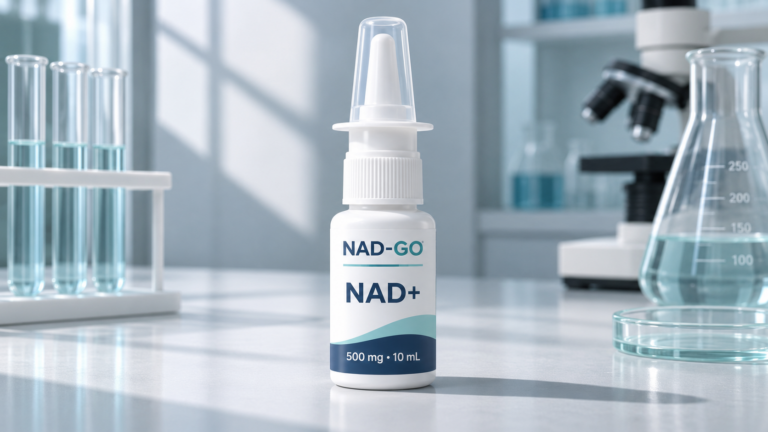
Our available NAD+ nasal spray is a defined research-product format, supported by our wider approach to material quality and batch documentation.
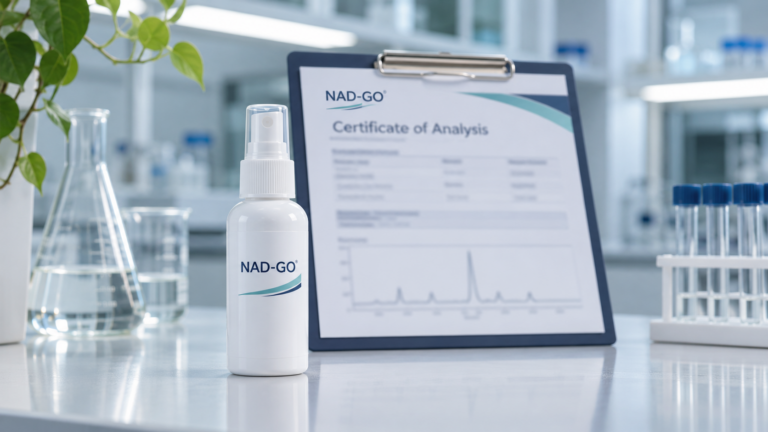
Our quality and compliance framework describes controls involving supplier qualification, traceability and analytical verification.
Those controls are important for research materials, but they answer different questions from pharmacokinetic or clinical investigations.
An analytical report establishing material purity does not establish absorption.
Likewise, an experimental study involving an NAD formulation does not validate the performance of every other formulation containing the same compound.
Keeping these categories separate is essential.
Where Research Should Go Next
The 2026 findings provide several potential directions for further investigation.
One is replication in other models of olfactory dysfunction.
Another is determining the extent to which the observed effects depend on local tissue responses rather than broader systemic processes.
A third is examining the chemical fate of intranasally administered NAD+, including whether intact NAD+ or relevant metabolites can be detected in particular biological compartments.
There are also questions about formulation-dependent behaviour.
Different preparations may produce different deposition patterns, chemical stability profiles or tissue exposure characteristics.
These questions require experiments designed to investigate them directly.
Primary Scientific Reference
Yoo, S. H., Jang, J. Y., Bae, J. S., et al. (2026).
Therapeutic effect of intranasal nicotinamide adenine dinucleotide in the restoration of olfactory dysfunction.
Experimental & Molecular Medicine, 58, 2155–2167.
Published 1 July 2026.
For more background on the biochemical functions of NAD+, see our NAD+ research overview. Additional technical discussions are available in the NAD-GO Research Journal.
Our Interpretation
This paper adds meaningful experimental evidence to a developing area of NAD+ research.
Its value lies in the combination of cell-culture work, animal experiments, tissue analysis and molecular measurements.
The findings are sufficiently interesting to justify further investigation.
They are not a substitute for human pharmacokinetic studies, clinical trials or product-specific testing.
For NAD-GO, that distinction is important. Our role as a research-product supplier is to provide appropriately characterised materials and communicate the science without extending the evidence beyond what the experiments actually demonstrate.
All NAD-GO products are intended exclusively for laboratory and scientific research, not for human or veterinary administration.