Nicotinamide adenine dinucleotide is essential to cellular metabolism, but NAD+ is not a static resource.
Within cells, the molecule is repeatedly used, regenerated and consumed.
Some biochemical reactions convert NAD+ into NADH and subsequently regenerate the oxidised coenzyme. Others use NAD+ as a substrate and release nicotinamide, creating a need for further biosynthesis.
One of the principal routes by which cells maintain their NAD+ supply is the nicotinamide salvage pathway.
For researchers studying NAD+ and its precursors, understanding this process is essential.
At NAD-GO, the pathway is particularly relevant because our research range includes NAD+ itself as well as related precursor compounds.
The Salvage Pathway in Two Principal Reactions
The simplified nicotinamide salvage pathway is:
Nicotinamide (NAM) → Nicotinamide Mononucleotide (NMN) → NAD+
Two enzyme-catalysed reactions make this possible.
NAMPT: Converting Nicotinamide Into NMN
Nicotinamide phosphoribosyltransferase (NAMPT) catalyses the conversion of nicotinamide into NMN.
The reaction uses phosphoribosyl pyrophosphate as a substrate.
NAMPT is an important regulatory component of NAD+ salvage metabolism because it contributes to the recycling of nicotinamide released by NAD+-consuming reactions.
Researchers studying NAMPT activity are therefore investigating one part of the cellular machinery responsible for maintaining NAD+ availability.
NMNAT: Converting NMN Into NAD+
The second reaction is catalysed by nicotinamide mononucleotide adenylyltransferase (NMNAT) enzymes.
These enzymes convert NMN into NAD+, using ATP as a substrate.
Mammalian cells express three principal NMNAT isoforms: NMNAT1, NMNAT2 and NMNAT3.
They differ in cellular distribution and biological context.
This makes the pathway more complicated than a simple chemical sequence might suggest.
NAD+ biosynthesis takes place within a highly organised cellular environment.
Learn more about the difference between NAD+ vs NMN vs NR
Where Does Nicotinamide Riboside Enter?
Nicotinamide riboside (NR) provides another route into NAD+ biosynthesis.
NR can be phosphorylated by nicotinamide riboside kinases to form NMN.
NMN can then enter the NMNAT-dependent conversion step leading to NAD+.
The relationship is commonly represented as:
NR → NMN → NAD+
This does not mean that NAD+, NMN and NR are equivalent compounds.
They occupy different positions in the pathway and have distinct molecular structures.
For laboratory research, that distinction determines which material is relevant to a particular experimental question.
How This Relates to the NAD-GO Research Range
NAD-GO supplies research products involving NAD+ and its related precursors.
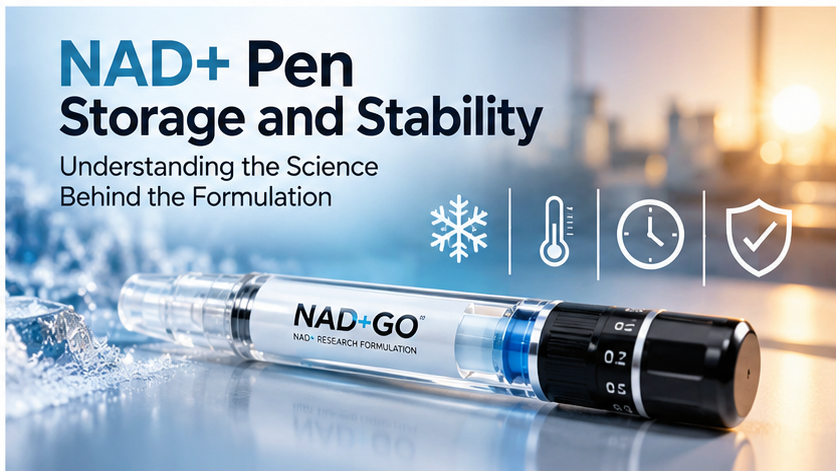
Our NAD+ pen range contains prepared formulations of the coenzyme itself.
NMN and NR products, by comparison, involve compounds that participate upstream in NAD+ biosynthesis.
This means the chemical identity of each formulation matters.
A product containing NMN should not be labelled or evaluated as though it contains NAD+ simply because NMN can be converted into NAD+ within biological systems.
Likewise, research results involving one precursor cannot automatically establish the behaviour of another compound.
These differences are fundamental to interpreting NAD+ research accurately.
The Salvage Pathway Is Not the Only Source of NAD+
Cells also maintain NAD+ through other biosynthetic pathways.
The de novo pathway uses tryptophan-derived intermediates.
The Preiss–Handler pathway uses nicotinic acid.
These pathways contribute to the broader network of NAD+ metabolism.
Their relative importance varies according to cell type, tissue and metabolic conditions.
Consequently, it would be inaccurate to describe the nicotinamide salvage pathway as the sole means of producing NAD+.
Why Cellular Compartmentalisation Matters
NAD+ metabolism is organised across different cellular compartments.
The nucleus, cytosol and mitochondria have different biochemical functions and can maintain distinct NAD-related metabolic environments.
This matters when interpreting laboratory measurements.
An increase in total cellular NAD+ does not necessarily demonstrate an equivalent increase within every compartment.
Likewise, changes in NAD+ abundance do not automatically establish changes in all NAD+-dependent enzyme activities.
Researchers must consider what was measured, where it was measured and which biological pathway was being investigated.
From Biological Pathways to Chemical Materials
Understanding the salvage pathway helps explain why NAD+ precursor research has attracted attention.
However, an intracellular biosynthetic pathway is not equivalent to a claim about the performance of an externally supplied product.
The activity of NAMPT or NMNAT enzymes inside cells does not establish the bioavailability or therapeutic effects of a specific NAD+ preparation.
At NAD-GO, our approach to research materials is based on defined compound identities, analytical verification and controlled formulation processes.
Our certifications and compliance information explains the quality framework supporting those research products.
What the Pathway Tells Researchers
The salvage pathway demonstrates how cellular NAD+ availability depends on ongoing chemical conversion and recycling.
NAMPT and NMNAT are central to the nicotinamide route, while related precursor pathways provide additional inputs to NAD+ biosynthesis.
For laboratories, understanding these mechanisms informs the selection of compounds, the design of experiments and the interpretation of biochemical findings.
It also reinforces a principle that guides our product development: related molecules should be characterised and evaluated according to their actual chemical identities.
Further discussion of NAD+ metabolism, analytical methods and formulation science is available in the NAD-GO Research Journal.
All NAD-GO research products are supplied solely for scientific and laboratory research and are not intended for human or veterinary administration.