NAD+, NMN and NR are often grouped together because all three participate in the biology of nicotinamide adenine dinucleotide. From a laboratory formulation perspective, however, they are different research materials.
They have different chemical structures, positions within metabolic pathways and analytical requirements.
At NAD-GO, this distinction is directly relevant to our product development. Our research range includes NAD+ formulations alongside products containing nicotinamide mononucleotide (NMN) and nicotinamide riboside (NR).
We do not regard these compounds as interchangeable simply because they are connected through NAD+ metabolism.
Three Molecules, Three Different Roles
NAD+ — the coenzyme
Nicotinamide adenine dinucleotide is directly involved in oxidation-reduction reactions and serves as a substrate for several enzyme families involved in cellular signalling.
NMN — a biosynthetic intermediate
Nicotinamide mononucleotide is converted into NAD+ by nicotinamide mononucleotide adenylyltransferase enzymes, known as NMNATs.
NR — an upstream precursor
Nicotinamide riboside can enter NAD+ biosynthesis through phosphorylation by nicotinamide riboside kinases, producing NMN.
These relationships can be represented simply:
NR → NMN → NAD+
A separate NAD salvage route converts nicotinamide into NMN through the enzyme NAMPT.
The resulting network is more complex than this simple diagram, but the distinction between the molecules is fundamental.
Why the Differences Matter to NAD-GO
Our product range includes separate NAD+, NMN and NR formulations.
The distinction is not simply branding.
Different chemical compounds require appropriate material identification, formulation considerations and analytical specifications.
A supplier should not assume that an analytical method validated for one compound automatically establishes the identity or purity of another.
This is especially important when working with related metabolites.
A sample labelled as NAD+ should contain the declared compound, not merely another molecule associated with the same metabolic pathway.
Our independent UK analytical testing arrangements, described in our quality and compliance documentation, are intended to support confidence in the research materials we supply.
Comparing the Chemistry
| Consideration | NAD+ | NMN | NR |
|---|---|---|---|
| Main biological role | Coenzyme and enzyme substrate | NAD+ biosynthetic intermediate | NAD+ precursor |
| Key metabolic relationship | Used and regenerated in cells | Converted into NAD+ by NMNAT | Converted into NMN by NRK |
| Chemical identity | Dinucleotide | Mononucleotide | Nucleoside |
| Research interpretation | Direct NAD+ metabolism | Precursor conversion | Precursor conversion |
| Analytical verification | Compound-specific | Compound-specific | Compound-specific |
This is also why published results involving NR cannot automatically be applied to NAD+ formulations.
Even when two compounds are connected biologically, their behaviour in an experimental system may differ.
What Do Human Studies Show?
NR and NMN have attracted interest because some human studies have reported changes in circulating NAD-related metabolites following supplementation.
However, increases in biochemical markers do not automatically demonstrate improvements in health outcomes.
Studies differ in their populations, interventions, analytical methods and endpoints.
The evidence is also not directly transferable to other products containing NAD+.
That distinction is particularly important for research manufacturers. We should not present findings involving oral precursor compounds as proof of the effects of an NAD+ dispensing pen.
Our NAD+ science resource examines the underlying biological interest without establishing clinical efficacy for our research formulations.
Formulation Is a Separate Scientific Question
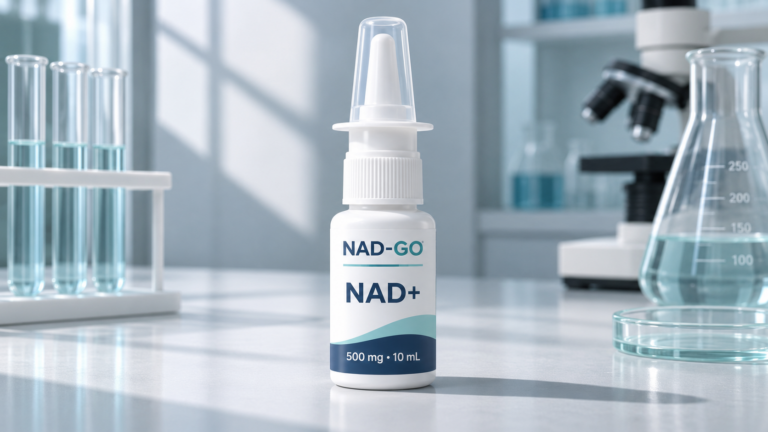
NAD-GO’s existing NAD+ research pen range includes stabilised liquid preparations containing the coenzyme itself.
Producing a prepared research formulation involves considerations beyond the biological role of its active compound.
These include chemical identity, concentration, solution compatibility, storage conditions and analytical verification.
The same broad principles apply to other research compounds, but the specific formulation requirements should not be assumed identical.
For example, demonstrating the stability of one NAD+ formulation would not independently establish stability for an NR preparation.
The formulation must be evaluated on its own characteristics.
What This Means for Research Customers
When comparing NAD+, NMN and NR products, we believe the first question should be what the intended experiment actually requires.
Is the experiment studying the NAD+ molecule itself, a precursor-conversion pathway or the activity of a particular enzyme?
Once that question is established, the required material, analytical specification and formulation become easier to define.
This is a more rigorous approach than treating NAD+, NMN and NR as alternative versions of one product.
Our Approach
At NAD-GO, we develop and supply research formulations with an emphasis on defined chemical identity, high-purity materials and transparent product information.
Our Research Journal explores related questions in NAD+ metabolism and formulation science.
The central lesson is that biochemical relationships do not erase chemical differences.
Understanding those differences is essential when designing research and evaluating the materials used within it.
Further Reading
- Covarrubias et al. (2021), NAD+ metabolism and its roles in cellular processes during ageing, Nature Reviews Molecular Cell Biology.
- Mehmel et al. (2020), NAD+ metabolism and the role of NR and NMN, Nutrients.
All NAD-GO products are supplied for laboratory research, not for human or veterinary use.