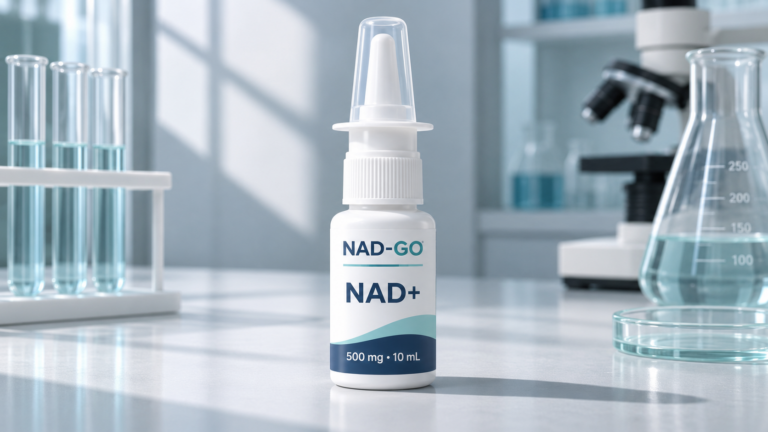
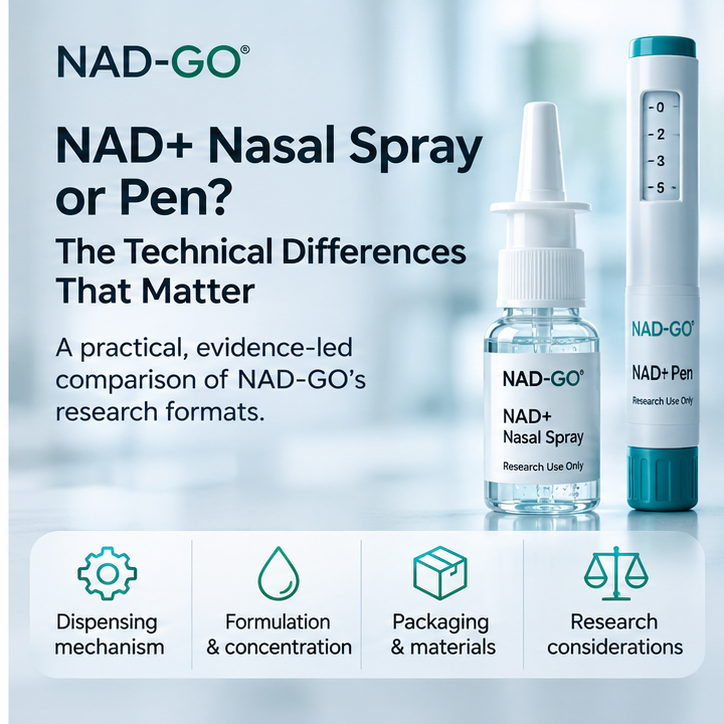
NAD-GO currently supplies two formats of liquid nicotinamide adenine dinucleotide (NAD+) research products: pre-filled research pens and NAD+ nasal spray.
The most important differences between them are mechanical and formulation-related.
Our pens use cartridges and an adjustable click-dial mechanism to displace liquid.
Our nasal spray uses a bottle and spray actuator, introducing atomisation and spray-pattern characteristics into the dispensing process.
Both products are available from NAD-GO, but they should not be treated as equivalent simply because they contain the same underlying research compound.
Here is how we compare them from a technical perspective.
First, Compare What Is Actually Specified
Our NAD+ research pen range contains three declared cartridge strengths.
The nominal concentrations can be calculated from the total mass and liquid volume.
| NAD-GO pen | Declared content | Cartridge volume | Nominal concentration |
|---|---|---|---|
| 200mg | 200mg NAD+ | 2ml | 100mg/ml |
| 500mg | 500mg NAD+ | 3ml | 166.7mg/ml |
| 1000mg | 1000mg NAD+ | 3ml | 333.3mg/ml |
These figures describe the nominal formulation specifications.
They should not be confused with independently measured finished-product assay results.
The NAD+ nasal spray is also available to purchase, but the current public product description does not provide a complete numerical specification for bottle volume, NAD+ concentration or output per actuation.
Those details are necessary before a direct quantitative comparison can be made.
It would be misleading to calculate an equivalent number of pen increments or an equivalent quantity per spray without them.
The Pen: Controlled Liquid Displacement
The pen is based on a mechanical displacement system.
An adjustment of the device moves an internal mechanism, which advances a plunger within the cartridge.
The resulting movement displaces liquid.
Several technical properties are relevant when evaluating this system.
Resolution describes the nominal size of the smallest adjustable increment.
Repeatability describes how consistently the mechanism can dispense the same volume under comparable conditions.
Accuracy describes how closely the actual dispensed volume matches its intended value.
These are separate characteristics.
A click-dial mechanism can provide many adjustment positions without necessarily demonstrating high accuracy.
Its performance depends on calibration, mechanical tolerances and the physical characteristics of the liquid.
For research purposes, the appropriate measurement depends on what the experiment requires.
The Spray: Liquid Atomisation
A nasal spray uses a different dispensing principle.
The actuator forces liquid through a nozzle, producing a distribution of droplets.
This introduces characteristics that are not central to the operation of a conventional displacement pen.
The most relevant include delivered spray volume, droplet-size distribution, spray pattern and consistency across repeated actuations.
For a metered spray system, researchers may also evaluate performance at different stages of the container’s intended operating life.
These characteristics are recognised in nasal spray formulation and device development.
However, they describe physical performance.
A particular spray pattern or droplet size does not establish that NAD+ has crossed a biological barrier.
Why Spray Output Is Not the Same as NAD+ Content
Suppose a spray device delivers a particular liquid volume per actuation.
That measurement describes the volume of formulation expelled.
To determine the corresponding nominal mass of NAD+, the concentration of the liquid is also needed.
The relationship is:
NAD+ mass = Dispensed liquid volume × NAD+ concentration
This calculation is useful in laboratory formulation analysis, but its accuracy depends on the underlying values.
A nominal device output should not be mistaken for independently verified output.
Similarly, a declared solution concentration should be distinguished from a laboratory assay.
Without verified specifications for both, a direct numerical comparison between the nasal spray and a pen would be incomplete.
The Packaging Introduces Different Quality Questions
The liquid inside a dispensing device must remain compatible with the materials it contacts.
For a pen, relevant components can include the cartridge, plunger and associated seals.
For a spray, the bottle, pump, nozzle and sealing components may be relevant.
These systems can introduce different considerations for formulation compatibility and stability.
This is why finished-product assessment matters.
A purity result for the NAD+ starting material does not automatically establish that the finished formulation remains chemically stable inside a particular container.
The two products need to be evaluated according to their own packaging and formulation specifications.
Does One Format Offer Better Chemical Stability?
That cannot be established from the container type alone.
NAD+ stability depends on factors including pH, temperature, solvent composition and storage duration.
NAD-GO’s pre-filled pen range uses a stabilised liquid formulation.
The nasal spray represents a different dispensing and packaging system.
Even where the same research compound is involved, the evidence supporting one product’s stability should not simply be transferred to the other.
Our separate technical article, Why NAD+ Nasal Spray Stability Depends on More Than Purity, examines this distinction in greater detail.
What Can Analytical Testing Tell Us?
NAD-GO’s quality framework includes controlled sourcing, batch documentation, traceability and independent analytical verification where appropriate.
Our certifications and compliance page provides details of that framework.
For both pens and nasal spray, chemical testing can help assess characteristics such as compound identity and purity.
Quantitative assays can be used to assess concentration.
However, device testing involves different questions.
A pen may require measurement of volume displacement and repeatability.
A spray may require assessment of delivered volume and relevant spray characteristics.
These tests should not be treated as interchangeable.
A product can meet its chemical specification while still requiring separate verification of dispensing performance.
What About Absorption and Bioavailability?
This is where comparisons between the two formats require particular caution.
Neither the presence of a pen mechanism nor the production of a spray establishes the biological fate of the NAD+ formulation.
The physical delivery process and subsequent biological processes are separate questions.
For intranasal NAD+, published research remains limited.
A July 2026 study in Experimental & Molecular Medicine investigated NAD+ in cultured human olfactory stem cells and an animal model of olfactory dysfunction.
It did not establish human systemic bioavailability or a clinically effective NAD+ nasal spray product.
Our detailed review, What the Latest Research Tells Us About Intranasal NAD+, examines that paper and its limitations.
Research involving other NAD+ formulations or NAD+ precursors also cannot automatically establish the comparative biological performance of the two products.
A Third Approach: Dual-Chamber Technology
NAD-GO is developing a dual-chamber auto-mixing NAD+ pen.
This forthcoming device is intended to keep lyophilised NAD+ separate from a liquid diluent until the mixing stage.
The objective is different from simply changing the way liquid leaves a container.
It introduces a separate preparation mechanism intended to combine storage and reconstitution within a single system.
The dual-chamber pen remains in development.
Its intended features should therefore be distinguished from verified performance characteristics of the products already available.
Which Format Is More Appropriate for Research?
The answer depends on the experimental requirements.
A laboratory evaluating precise liquid displacement may be concerned with calibration, cartridge geometry and volumetric accuracy.
A laboratory examining spray-device behaviour may instead need information about output consistency, droplet characteristics and nozzle performance.
Other experiments may require a formulation with a particular buffer system or concentration.
The most appropriate format is the one whose documented specifications align with the requirements of the research.
Neither should be presumed superior because of its appearance or dispensing technology.
The NAD-GO Product Range
NAD-GO supplies NAD+ pre-filled research pens and NAD+ nasal spray as commercially available research products.
We also continue to develop alternative dispensing and formulation technologies.
For more information on the company and its approach to material quality, visit About NAD-GO.
The important principle is that engineering specifications, chemical quality and biological evidence must be considered separately.
That distinction allows laboratories to assess research products according to measurable characteristics rather than unsupported assumptions about their performance.
All NAD-GO research products are supplied exclusively for laboratory and scientific research and are not intended for human or veterinary administration.