A claim of 99.99% purity is easy to print on a label. Establishing what that figure represents is considerably more demanding.
When evaluating nicotinamide adenine dinucleotide (NAD+) for laboratory research, we distinguish between the identity of the compound, the purity of the tested material and the composition of the finished formulation.
These are not interchangeable measurements.
At NAD-GO, our approach combines high-purity NAD+ sourcing, controlled manufacturing procedures, batch traceability and independent analytical testing through a specialist laboratory in the United Kingdom.
We have also visited our independent laboratory partner to review its facilities, testing environment and analytical capabilities. That matters to us because selecting an analytical partner involves more than simply receiving a certificate containing a percentage.
Why We Use Independent Laboratory Analysis
Manufacturing quality controls are necessary, but we also value having analytical results produced independently of the manufacturing process.
Our UK laboratory partner has capabilities that include high-performance liquid chromatography (HPLC), mass spectrometry and other analytical techniques used to evaluate chemical materials.
Different tests answer different questions.
An HPLC purity assessment may help establish the proportion of detectable components represented by the intended compound.
Mass spectrometry can provide evidence supporting molecular identity.
Quantitative assays can establish the measured concentration or content of a substance when appropriately validated.
Impurity profiling may identify additional compounds present in a sample.
No single technique automatically establishes every aspect of research-product quality.
What an HPLC Result Actually Shows
HPLC separates components of a sample according to their interactions with a chromatographic system.
The result is a chromatogram containing peaks representing detected components.
For an NAD+ sample, a validated HPLC method can help distinguish the principal compound from certain impurities or degradation products.
However, the reported purity percentage requires careful interpretation.
A result calculated using chromatographic peak-area normalisation describes the proportion of the integrated detector response attributable to the relevant peak.
It does not necessarily establish that the same percentage of the sample’s total mass consists of NAD+.
Other components may respond differently to the detector or fall outside the scope of the method.
This is why we believe the analytical method matters as much as the headline result.
Why Molecular Identity Requires Separate Consideration
A prominent chromatographic peak does not, by itself, provide comprehensive confirmation of chemical identity.
Mass spectrometry can support identification by measuring the mass-to-charge characteristics of detected ions.
When combined with appropriate reference information and chromatographic techniques, it provides useful evidence about the compound being investigated.
Our laboratory partner has access to mass spectrometry capabilities, allowing identity-related questions to be considered alongside chromatographic analysis.
The precise conclusions supported by any individual batch report depend on the tests actually performed.
From High-Purity NAD+ Material to a Finished Research Pen
NAD-GO offers a pre-filled NAD+ research pen in three strengths:
| Formulation | Total NAD+ | Nominal concentration |
|---|---|---|
| 200mg / 2ml | 200mg | 100mg/ml |
| 500mg / 3ml | 500mg | 166.7mg/ml |
| 1000mg / 3ml | 1000mg | 333.3mg/ml |
These concentrations are calculated from the declared mass and liquid volume.
There is an important distinction between establishing the purity of NAD+ starting material and establishing the concentration of a finished liquid formulation.
For example, a batch of raw NAD+ may meet a high chromatographic purity specification while the finished cartridge still requires verification of its concentration.
The reverse is equally important: a correctly measured concentration does not independently establish the complete impurity profile of the material.
This is why we consider chemical quality and finished-product specifications separately.
What Our 99.99% Purity Specification Means
NAD-GO specifies NAD+ material at a minimum purity of 99.99%, supported by independent batch testing.
We believe that purity claims should be interpreted alongside the appropriate analytical documentation.
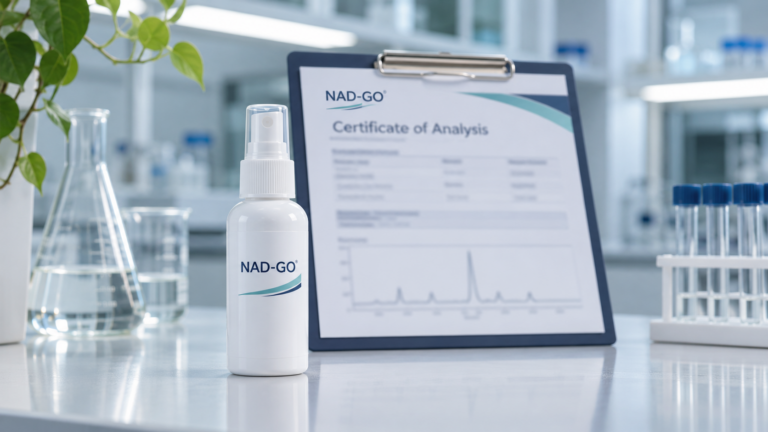
A meaningful evaluation should establish whether the certificate of analysis relates to the starting material or finished formulation, which analytical method was used and how the result was calculated.
A figure alone cannot establish every characteristic of a research product.
We also avoid treating high chemical purity as proof of sterility, long-term stability or clinical suitability. Those require separate evidence.
Why Batch Traceability Is Important
An analytical result is useful only when it can be connected to the material being evaluated.
Our quality framework includes batch identification, documentation and defined controls intended to support consistency across manufacturing and distribution.
This is particularly relevant where several cartridge strengths are produced.
An analytical result from one formulation or batch should not automatically be assumed to apply to another.
Our certifications and compliance framework explains the GMP-aligned principles and documentation controls that underpin this approach.
Why Visual Appearance Is Not a Purity Test
Our formulations are designed to have a clear appearance, and we regard unexpected cloudiness, particles or discolouration as reasons for further assessment.
However, colour is not a substitute for laboratory analysis.
A visually clear solution may still contain impurities that are not apparent to the naked eye.
Likewise, an altered appearance cannot conclusively identify a specific degradation product.
This is why we distinguish visual product inspection from analytical verification.
What We Look for in Credible Analytical Evidence
When evaluating research-product documentation, the questions we consider include:
- Has the compound been correctly identified?
- Does the report specify the analytical technique?
- Is the reported purity calculated on a clearly defined basis?
- Can the results be connected to an identifiable batch?
- Does the certificate relate to raw material or the finished formulation?
- Are other relevant specifications supported by separate evidence?
These questions provide a more meaningful view of quality than simply comparing two suppliers’ headline purity percentages.
Our Position on Research-Product Quality
NAD-GO is focused on supplying research materials with defined specifications, transparent documentation and independent analytical verification.
Our approach is described further in About NAD-GO, while our Research Journal covers additional developments in NAD+ science and manufacturing.
Ultimately, a purity percentage is only the beginning of a technical assessment.
What matters is the evidence behind it, the quality of the analytical method and the extent to which that evidence can be traced to the actual material supplied.
All NAD-GO products are supplied exclusively for laboratory and scientific research and are not intended for human or veterinary administration.