The stability of a research compound depends on more than its initial purity.
For nicotinamide adenine dinucleotide (NAD+), factors such as temperature, pH, solvent composition and storage duration can influence how the molecule behaves outside a biological system.
These considerations are particularly important for liquid NAD+ formulations, where the compound remains dissolved throughout the intended storage period.
At NAD-GO, formulation stability is a central consideration in the development of our pre-filled research pens.
Our current range uses a buffered liquid formulation designed for room-temperature storage under specified conditions, while our next-generation dual-chamber technology explores an alternative approach involving freeze-dried NAD+.
Understanding the underlying chemistry helps explain why these two designs differ.
Why Does NAD+ Stability Matter?
NAD+ is an essential coenzyme involved in oxidation-reduction reactions and various enzyme-dependent biological processes.
Its chemical structure enables it to participate in these reactions, but the molecule’s stability can also be influenced by its surrounding environment.
When NAD+ is stored in a liquid formulation, degradation processes may reduce the concentration of intact NAD+ over time.
This can affect the chemical composition of the research material.
For laboratories conducting analytical experiments, such changes are important because the composition of the material must remain sufficiently consistent for the intended procedure.
The purity of the original NAD+ compound is therefore only part of the picture.
The condition of the finished formulation during storage also matters.
How Temperature Influences NAD+ Formulations
Temperature is an important variable in chemical stability.
Many chemical degradation processes proceed more quickly at elevated temperatures.
For this reason, conventional NAD+ laboratory solutions are often stored under controlled low-temperature conditions.
However, there is no single storage rule that applies to every formulation.
The behaviour of NAD+ depends on the complete chemical environment, including the solvent and any buffering components.
A formulated solution may have different stability characteristics from NAD+ dissolved in an unbuffered aqueous medium.
This is why storage instructions should be based on product-specific evidence rather than a general assumption that every NAD+ solution must be frozen or refrigerated.
The Role of pH in NAD+ Stability
pH describes the acidity or alkalinity of a solution.
Changes in pH can influence the chemical reactions that occur within a formulation, including degradation.
NAD+ and its reduced counterpart, NADH, are chemically related but do not have identical stability characteristics.
Research has demonstrated that the behaviour of nicotinamide cofactors depends on factors including temperature and pH.
This creates an important challenge during formulation development.
A liquid product must be designed around the stability requirements of the actual compound it contains.
Simply choosing a buffer that works well for another biological molecule does not establish suitability for NAD+.
Why NAD-GO Uses a Buffered Formulation
A buffer is a chemical system that helps resist changes in pH.
By maintaining a more controlled chemical environment, a suitable buffer can support formulation stability under appropriate conditions.
However, buffers do not make compounds indefinitely stable.
Their effectiveness depends on factors including buffer composition, concentration, temperature and interactions with the dissolved compound.
NAD-GO’s existing research pens use a buffered formulation intended to maintain NAD+ under the product’s specified storage conditions.
This approach forms part of our wider focus on research formulation quality and product consistency.
Importantly, the stability characteristics belong to the complete formulation, not simply to the mechanical pen device.
The presence of a cartridge does not independently prevent chemical degradation.
Room-Temperature Storage: What Does It Actually Mean?
NAD-GO describes its pre-filled formulation as suitable for room-temperature storage.
This means the product is designed to be maintained without continuous refrigeration when the defined storage conditions are observed.
It does not mean that the formulation can be exposed to unlimited heat, prolonged direct sunlight or uncontrolled environmental conditions.
Nor does room-temperature stability mean indefinite shelf life.
A meaningful stability claim should identify the relevant temperature conditions, supported duration and analytical acceptance criteria.
Research customers should rely on the current product instructions and supporting documentation rather than assuming that all ambient environments are equivalent.
For information about the available formulations, visit our NAD+ pen product page.
How Is NAD+ Formulation Stability Assessed?
Stability testing is a process of evaluating whether a material continues to meet defined specifications over time.
For an NAD+ solution, this may involve assessing:
- The concentration of intact NAD+
- Chemical impurity profiles
- Changes in pH
- Visual appearance
- Physical changes such as precipitation
- The effects of temperature and storage duration
High-performance liquid chromatography (HPLC) is one analytical technique that can be used to separate and measure chemical components.
A suitably validated stability-indicating method may be able to distinguish intact NAD+ from relevant degradation products.
However, a single purity measurement is not equivalent to a complete stability study.
A compound may meet its purity specification when initially manufactured while requiring further testing to establish how the finished formulation behaves during storage.
This is why batch release testing and long-term stability assessment serve different purposes.
Why a Clear Solution Does Not Prove Purity
Visual appearance can provide useful information about a formulation, but it has limitations.
A solution that develops visible particles, cloudiness or unexpected discolouration may require investigation.
However, a clear, colourless solution is not necessarily chemically pure.
Some degradation products may be present without causing an obvious visible change.
Similarly, changes in appearance do not identify a particular impurity without analytical evidence.
For research purposes, visual checks should therefore complement rather than replace appropriate chemical testing.
Why We Are Developing a Dual-Chamber NAD+ Pen
Liquid formulation stability is one reason alternative cartridge technologies are of interest.
Our forthcoming dual-chamber auto-mixing NAD+ pen is being developed around a different formulation approach.
The proposed device separates freeze-dried NAD+ from a compatible liquid diluent.
The components remain in separate cartridge chambers until an integrated mixing mechanism is activated.
This design seeks to bring together the potential storage advantages of a dry formulation with the convenience of an integrated dispensing device.
The process of lyophilisation, or freeze-drying, removes water from a preparation under controlled conditions.
For suitable compounds, reducing water content can help limit certain degradation pathways.
Nevertheless, the stability of a lyophilised formulation still depends on its chemical composition, packaging and storage environment.
Our dual-chamber system remains in development. Its final stability characteristics will need to be supported by testing before definitive performance claims can be made.
Quality Control and Batch Documentation
Stability is one element of a broader product-quality framework.
At NAD-GO, our approach includes supplier qualification, documented handling procedures, batch traceability and analytical verification.
These processes are described in our certifications and compliance framework.
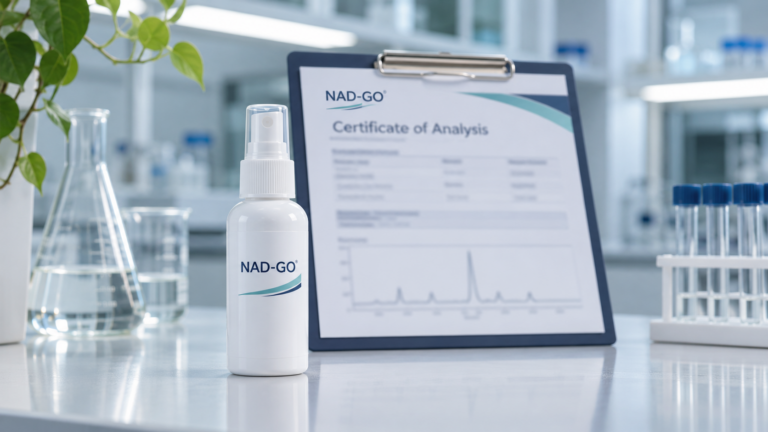
A Certificate of Analysis can help researchers understand the tested characteristics of a particular batch.
However, the specific tests listed on the certificate determine what conclusions can be drawn.
A raw-material purity result should not be presented as proof of finished-product shelf life unless the appropriate supporting evidence exists.
Scientific Research and Further Reading
The influence of storage conditions on nicotinamide cofactors is an established area of biochemical research.
For example, studies examining the stability of NAD+ and NADH in aqueous solutions demonstrate the importance of considering environmental and formulation conditions when handling these compounds.
Readers interested in the wider scientific context can explore our Research Journal, which covers NAD+ research, manufacturing and quality-related topics.
For background on the biological significance of NAD+, see our overview of NAD+ and cellular health research.
It is important to distinguish between published research on NAD+ chemistry and evidence relating to a particular commercial formulation. General scientific findings do not independently validate the storage claims of an individual product.
The NAD-GO Approach to Research Formulations
Our aim at NAD-GO is to combine high-purity NAD+ research materials with appropriate formulation technology and transparent product information.
You can learn more about our company, product development and quality-focused approach on the About NAD-GO page.
The existing pre-filled pen range and forthcoming dual-chamber system illustrate two different approaches to a common challenge: maintaining formulation quality while providing a practical laboratory dispensing format.
Final Thoughts
NAD+ storage stability depends on the chemical properties of the finished formulation, not simply the packaging in which it is supplied.
Temperature, pH, solvent composition, buffering and time can all influence the condition of a liquid NAD+ preparation.
For researchers, the most reliable approach is to examine product-specific storage instructions, analytical results and supporting stability documentation.
At NAD-GO, these considerations remain central to our work with pre-filled NAD+ formulations and the development of future cartridge technologies.
All NAD-GO research products are intended exclusively for laboratory and scientific research. They are not for human or veterinary administration.