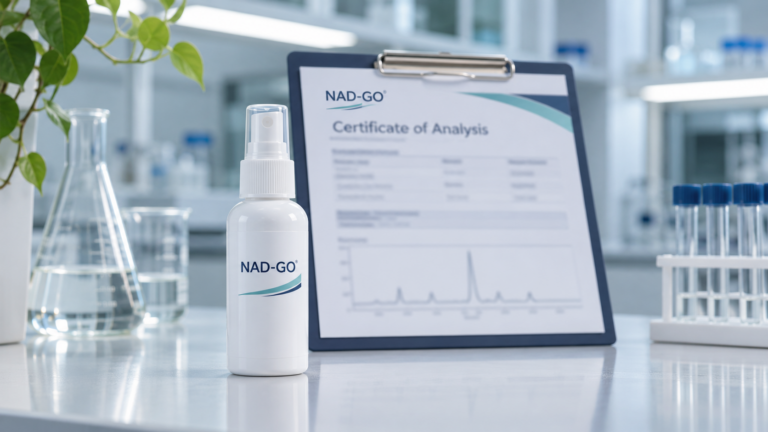
A Certificate of Analysis should help establish what was tested, how it was tested and whether the results meet a defined specification.
It should not be treated as a decorative addition to a research product page.
At NAD-GO, batch traceability and analytical documentation are part of our approach to research-material quality. We work with an independent UK analytical laboratory and maintain a GMP-aligned quality framework covering material handling, documentation and product controls.
We believe a useful Certificate of Analysis (COA) should allow a research customer to distinguish between a verified analytical result and a general supplier claim.
Here are the areas that matter most.
1. Does the Certificate Identify the Correct Material?
This is the first check.
The document should identify the compound and the material or sample that was tested.
For NAD+ products, this distinction becomes important because research suppliers may offer the compound in different physical forms.
A certificate relating to dry NAD+ starting material is not automatically a complete quality report for a finished liquid formulation.
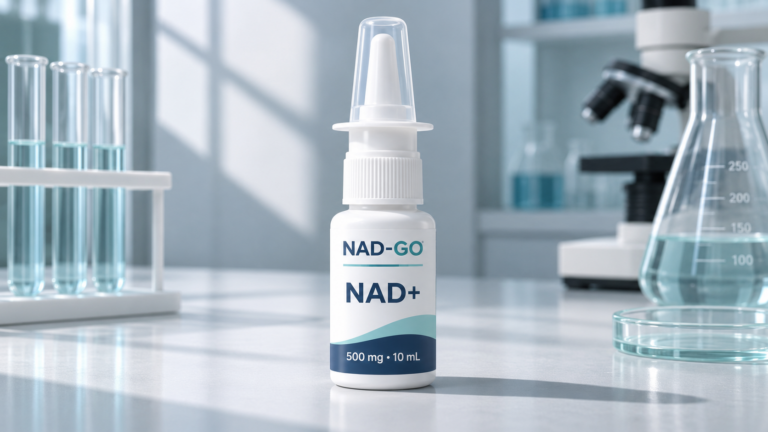
Our current NAD+ pen range includes three liquid strengths: 200mg/2ml, 500mg/3ml and 1000mg/3ml.
The relevant analytical documentation should make clear what material the reported test results actually concern.
2. Can the Report Be Traced to a Batch?
A certificate must be connected to an identifiable material or production batch to support meaningful traceability.
Our quality framework includes documented batch identification and release controls.
In practice, traceability matters because testing one batch does not establish that every later batch will have identical measured characteristics.
This is particularly relevant when comparing multiple strengths or production runs.
Our certifications and compliance page describes the principles underlying our documentation and traceability procedures.
3. What Does the Purity Percentage Mean?
NAD-GO specifies NAD+ purity of at least 99.99%.
However, the meaning of a reported percentage depends on how it was measured.
If purity is assessed using HPLC peak-area normalisation, the percentage reflects the proportion of the integrated detector response attributable to the specified peak.
That may differ from a mass-based assay of the total sample.
Consequently, it is important to examine the analytical method rather than comparing percentages without context.
A supplier reporting 99.99% chromatographic area purity and another reporting a different type of assay are not necessarily providing directly equivalent results.
4. Is Chemical Identity Supported?
Chemical identity and chemical purity are separate analytical questions.
A test may indicate a high proportion of one detected compound while additional evidence is needed to identify that compound conclusively.
Our UK analytical laboratory partner has capabilities including HPLC and mass spectrometry.
Mass spectrometry can support molecular identification through mass-to-charge measurements, while chromatography can help separate components of a sample.
The precise conclusion supported by a particular certificate depends on which tests were performed and the validation of the methods used.
We do not assume that one result establishes every property of the material.
5. Does the COA Verify the Finished Concentration?
For pre-filled NAD+ research pens, total compound mass and solution concentration are important but different measurements.
For example:
| Cartridge | Declared total NAD+ | Nominal concentration |
|---|---|---|
| 200mg/2ml | 200mg | 100mg/ml |
| 500mg/3ml | 500mg | 166.7mg/ml |
| 1000mg/3ml | 1000mg | 333.3mg/ml |
These are formulation specifications derived from declared quantities.
A raw-material purity certificate does not independently verify that a finished cartridge contains the stated concentration.
Where finished-product concentration needs to be established, an appropriate quantitative assay is required.
This distinction matters because a product may contain very high-purity starting material while still requiring further finished-product verification.
6. Does the Certificate Establish Stability?
Not unless it includes suitable stability evidence.
A result obtained at one point in time does not automatically establish that the formulation will meet its specifications after months of storage.
Stability assessment may involve repeated analytical measurements under defined conditions.
NAD-GO describes its existing pre-filled formulation as designed for room-temperature storage.
That claim should be interpreted according to the product’s supported conditions and any relevant formulation-specific stability evidence.
A COA showing initial purity should not be treated as a substitute for a shelf-life study.
7. Who Conducted the Analysis?
Independent laboratory testing can provide additional confidence when the laboratory, methodology and scope of testing are clearly identified.
At NAD-GO, we have visited our specialist UK analytical laboratory partner and reviewed its facilities and capabilities.
We regard this relationship as an important part of our approach to quality.
Nevertheless, a laboratory’s general capabilities should not be confused with a statement that every available test is carried out on every batch.
The individual report remains the authoritative record of what was actually measured.
What We Believe a Credible COA Should Demonstrate
A useful certificate should help researchers establish:
- The identity of the material tested.
- The batch or sample to which the document relates.
- The methods used.
- The acceptance criteria.
- The actual analytical results.
- The date and source of the testing.
- The limitations of the conclusions that can reasonably be drawn.
This information is considerably more meaningful than an unqualified purity figure displayed on a product label.
The NAD-GO Standard
NAD-GO’s approach combines high-purity research materials, independent analytical verification and GMP-aligned documentation controls.
Our wider company philosophy is explained in About NAD-GO, while related analytical and formulation topics are covered in our Research Journal.
For us, the purpose of analytical documentation is not simply to support a marketing statement.
It is to make research-product quality more transparent, traceable and open to technical scrutiny.
All NAD-GO products are supplied strictly for scientific and laboratory research and are not for human or veterinary administration.