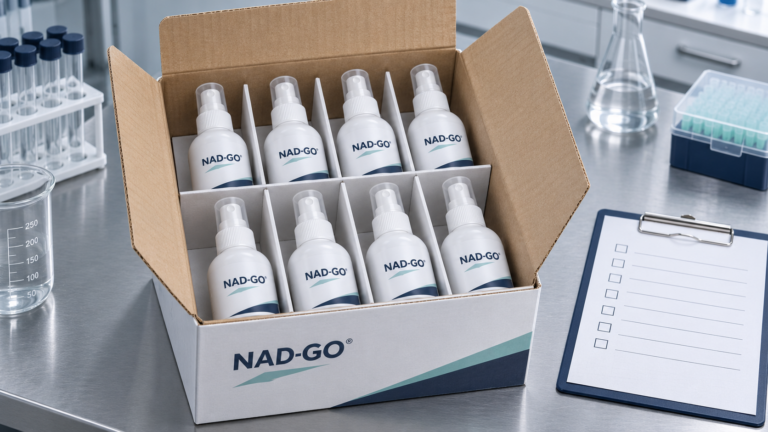
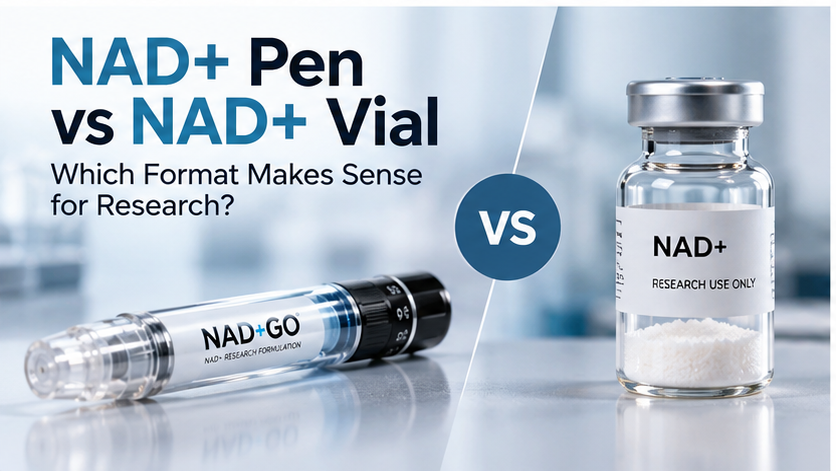
NAD+ research materials are available in several formats, including dry powders, lyophilised preparations, ready-made liquid solutions and pre-filled dispensing pens.
At first glance, the distinction between a pen and a vial appears straightforward: one includes a dispensing mechanism, while the other is a conventional laboratory container.
In practice, the differences can affect preparation requirements, formulation flexibility, measurement procedures and storage considerations.
For researchers working with nicotinamide adenine dinucleotide, the most appropriate format depends on the intended experimental method.
The Traditional NAD+ Vial
A laboratory vial is a container used to hold chemical research material.
In NAD+ research, vials may contain crystalline material, freeze-dried material or a prepared liquid solution.
A vial containing dry NAD+ allows researchers to prepare a solution using an appropriate solvent or buffer.
This provides control over formulation variables such as concentration and solvent composition.
For example, an analytical procedure may require a specific buffer or a particular concentration range.
Starting with dry material can give a laboratory the flexibility to prepare a formulation compatible with those requirements.
However, the preparation process introduces additional steps, and each step can influence the reproducibility of the resulting solution.
The Pre-Filled NAD+ Pen
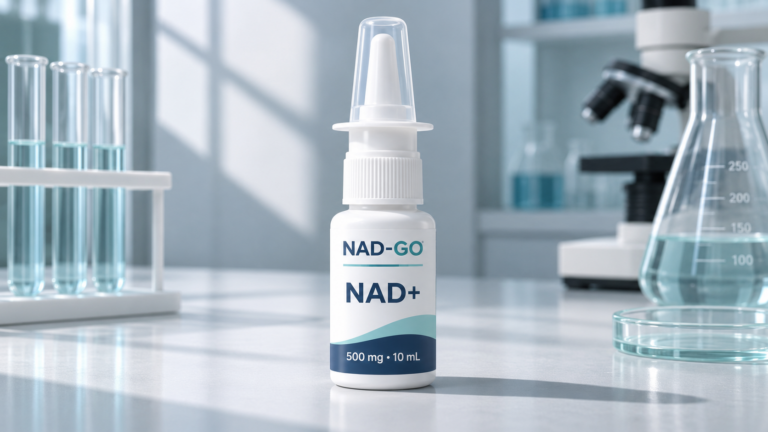
A pre-filled NAD+ pen approaches the same problem differently.
Instead of supplying the active material separately from the dispensing equipment, the formulation is prepared and incorporated into an integrated cartridge.
The NAD-GO NAD+ pen range contains three pre-filled configurations, with 200mg, 500mg and 1000mg of NAD+.
The principal advantage of this presentation is that the starting solution has already been formulated.
Researchers evaluating a pen do not need to undertake the same initial dissolution stage associated with a dry preparation, assuming the supplied formulation is compatible with the intended laboratory application. Check out this blog discussing what a NAD pen is
The trade-off is that the concentration and buffer system are already established.
Comparison of NAD+ Pens and Vials
| Consideration | Pre-filled NAD+ pen | Conventional NAD+ vial |
|---|---|---|
| Formulation | Prepared liquid | Dry or liquid |
| Initial preparation | No dry-material reconstitution | Depends on contents |
| Measurement | Integrated dispensing system | Separate liquid-handling equipment |
| Concentration flexibility | Fixed as supplied | Potentially adjustable during preparation |
| Buffer selection | Manufacturer-established | May be selected by the laboratory |
| Storage requirements | Specific to formulation | Specific to formulation |
| Quality evidence | Batch-specific documentation | Supplier-dependent |
| Research compatibility | Depends on device and solution | Depends on material and equipment |
Neither format is universally better.
The relevant differences become clearer when examined against a specific laboratory workflow.
Preparation and Reconstitution
Dry NAD+ preparations require an appropriate dissolution process before experiments that use a liquid solution.
The preparation method may involve variables such as the solvent, buffer, pH and final volume.
Each variable needs to be controlled when reproducibility is important.
A pre-filled pen removes some of these initial preparation stages because the liquid formulation is supplied ready-made.
However, fewer preparation steps should not automatically be interpreted as greater analytical reliability.
The reliability of the supplied solution still depends on manufacturing controls, concentration verification and stability.
Precision: Pen Mechanisms vs Laboratory Pipettes
Mechanical dispensing pens and laboratory pipettes operate according to different engineering designs.
A pen typically uses a plunger-driven mechanism that displaces a defined volume of liquid as the device is adjusted.
A laboratory pipette uses a calibrated liquid-handling system to transfer measured volumes.
Both can support repeatable measurement under appropriate conditions.
However, accuracy should be demonstrated through testing rather than assumed from the presence of a precision mechanism.
A well-calibrated pipette may offer excellent measurement performance within its specified operating range.
Similarly, a properly characterised pen system may provide consistent volume displacement within its design limits.
For either format, suitability depends on the required measurement tolerances and the laboratory’s validated procedures.
Does a Sealed Pen Reduce Contamination?
A pre-filled cartridge can reduce the number of initial transfers required to prepare a solution.
Reducing handling steps may remove some opportunities for contamination.
That does not establish that a pen is sterile or free from all contamination risks.
Sterility, microbial contamination and chemical purity are different properties requiring different forms of testing.
A research-grade product should never be assumed suitable for sterile administration merely because the solution is contained inside an integrated device.
This distinction is particularly important for NAD+ research products, which are not authorised medicines.
The Importance of Storage Conditions
A freeze-dried NAD+ preparation may have different storage characteristics from a ready-made liquid formulation.
Lyophilisation removes much of the water from a preparation, which can improve stability for certain compounds and formulations.
However, the actual stability benefit depends on the chemical composition and validated storage conditions.
NAD-GO’s existing pen range uses a stabilised liquid formulation.
We are also developing a dual-chamber auto-mixing pen that aims to combine the storage of freeze-dried NAD+ with an integrated liquid reconstitution system.
In this design, the dry compound and diluent are held in separate chambers until mixing is required.
This forthcoming technology represents a different approach to the relationship between storage and preparation.
It remains under development, and its final performance specifications should not be assumed before validation.
Why Quality Documentation Matters More Than Packaging
Whether NAD+ is supplied in a vial or a pen, researchers need to understand the quality of the underlying compound.
NAD-GO uses a GMP-aligned quality framework incorporating supplier qualification, traceability and relevant analytical verification.
Our certifications and compliance page explains these processes and distinguishes our internal quality approach from formal GMP certification.
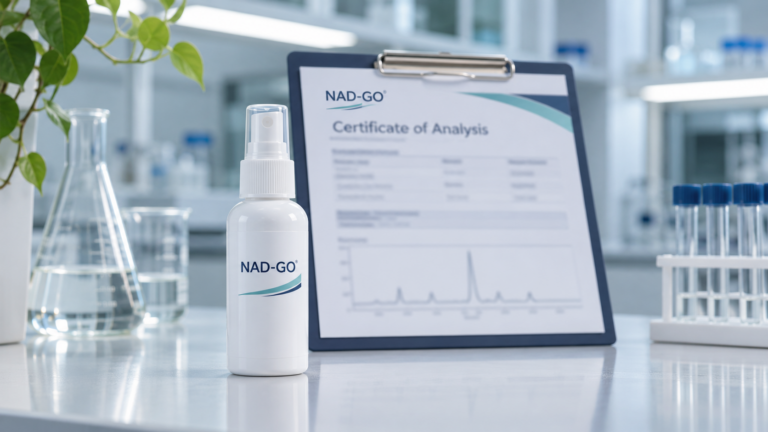
For a given batch, relevant documentation may include information about chemical identity, purity and other tested specifications.
A Certificate of Analysis should be interpreted according to the tests actually performed.
For example, a certificate establishing the purity of NAD+ starting material does not automatically establish the dispensing accuracy of a finished pen.
Those are separate technical characteristics.
Which Format Is Appropriate for a Laboratory?
A pre-filled pen may be relevant where a laboratory requires a defined, prepared formulation and an integrated dispensing mechanism.
A conventional vial may be preferable when the experimental procedure requires custom solvent selection, flexibility over sample preparation or compatibility with specialised analytical instrumentation.
The decision should be made according to the experiment’s technical requirements, not marketing descriptions of convenience or precision.
Our Approach at NAD-GO
At NAD-GO, our focus is on combining high-purity research materials with transparent technical specifications and controlled product presentation.
Our current pre-filled NAD+ pens are one part of that work, alongside the development of new cartridge technologies.
We also publish information on chemical research and manufacturing considerations through the NAD-GO Research Journal.
The central principle is that format should support the scientific requirements of the project. It should never replace proper analytical verification.
All NAD-GO research products are intended strictly for laboratory use and are not for human or veterinary administration.