A 1000mg NAD+ pen is not simply a larger version of a 200mg pen. Its total compound content, concentration and relationship between liquid volume and NAD+ mass are different.
Those distinctions matter when assessing formulations for laboratory research.
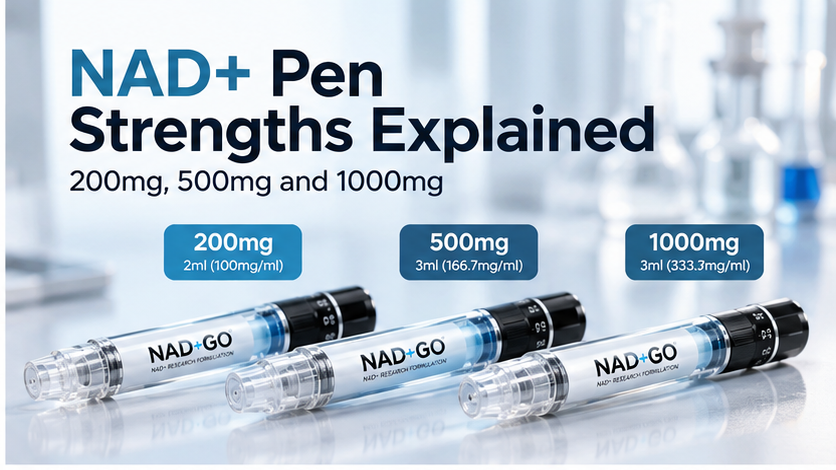
At NAD-GO, our pre-filled NAD+ research pens are available in 200mg, 500mg and 1000mg strengths. The range uses two cartridge volumes, 2ml and 3ml, creating three distinct concentrations. Here’s a closer look at what a NAD pen is.
This guide examines the technical differences and explains why the highest-strength formulation is not automatically the most appropriate for every research application.
Strength, Concentration and Volume: Three Different Measurements
Research product specifications frequently include milligrams (mg) and millilitres (ml). Although related, these units measure different things.
Milligrams describe mass. Millilitres describe liquid volume.
Concentration describes how much of a particular substance is present within a specified volume of solution.
For NAD+ formulations, concentration is commonly expressed in milligrams per millilitre (mg/ml).
The calculation is:
Concentration (mg/ml) = Total NAD+ mass (mg) ÷ Solution volume (ml)
For example, 200mg of NAD+ contained in a total solution volume of 2ml gives a nominal concentration of 100mg/ml.
This is a mathematical concentration based on the stated formulation specifications. An independently measured concentration would require an appropriate analytical assay.
Check our our blog explaining NAD Pen strengths.
NAD-GO’s Three Cartridge Configurations
The current NAD-GO NAD+ pen range includes the following formulations:
| Specification | 200mg | 500mg | 1000mg |
|---|---|---|---|
| Total NAD+ | 200mg | 500mg | 1000mg |
| Liquid volume | 2ml | 3ml | 3ml |
| Nominal concentration | 100mg/ml | 166.7mg/ml | 333.3mg/ml |
| Format | Pre-filled liquid | Pre-filled liquid | Pre-filled liquid |
| Dispensing system | Click-dial | Click-dial | Click-dial |
There are two particularly useful comparisons to make.
200mg vs 500mg
The 500mg formulation contains 2.5 times the total NAD+ mass of the 200mg formulation.
However, because the cartridges contain different liquid volumes, the 500mg solution is approximately 1.67 times as concentrated.
The difference in total compound quantity is therefore not proportionally identical to the difference in concentration.
500mg vs 1000mg
Both formulations use 3ml cartridges.
The 1000mg version contains twice the nominal mass of NAD+ within the same solution volume.
Consequently, its nominal concentration is exactly twice that of the 500mg configuration.
This comparison illustrates how different concentrations can be accommodated within cartridges of equal volume.
Why Concentration Matters in Laboratory Research
Concentration is important whenever the chemical composition of a measured liquid volume affects an experiment.
For example, suppose a laboratory is evaluating the chemical properties of NAD+ solutions at different concentrations.
The researcher needs to know not only the total quantity of available compound but also the relationship between liquid volume and NAD+ content.
Two cartridges containing equal volumes of liquid may deliver different amounts of compound when the solutions have different concentrations.
The researcher must also consider the suitability of the supplied buffer, analytical method and equipment.
Concentration alone does not determine the scientific value of a formulation.
Does Higher Strength Mean Higher Purity?
No.
This is one of the most important distinctions when comparing research chemicals.
A 1000mg cartridge contains more NAD+ than a 200mg cartridge, but the quantity of material does not establish its chemical purity.
Purity is assessed using analytical methods appropriate to the material being tested.
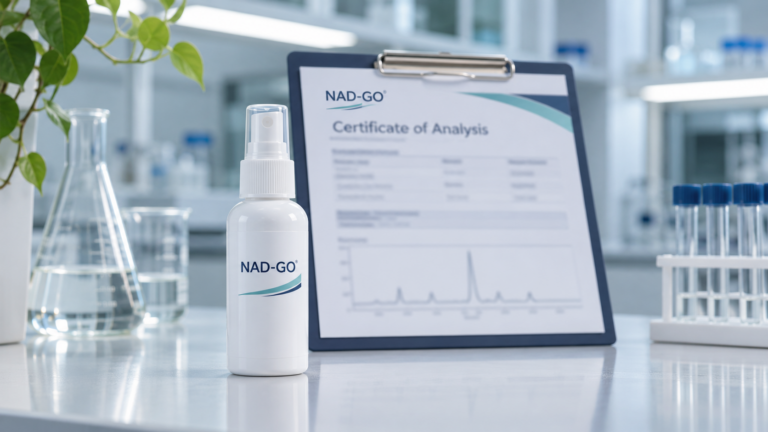
NAD-GO specifies at least 99.99% NAD+ purity and supports its product specifications with batch-specific analytical documentation.
However, a purity result for the starting compound should be distinguished from an assay measuring NAD+ concentration in the finished liquid formulation.
These tests can answer different questions.
Our quality and compliance information explains our approach to analytical verification and batch traceability.
Can Concentration Affect Formulation Stability?
Potentially.
The stability of a chemical solution can depend on concentration, pH, buffer composition, temperature and interactions between formulation components.
It would therefore be incorrect to assume that all three NAD+ strengths necessarily have identical stability profiles without formulation-specific evidence.
Likewise, a higher concentration should not automatically be described as more stable or less stable.
These are properties that must be established through suitable analytical testing.
The relevant product documentation should provide the basis for any shelf-life or storage claims.
Understanding the Role of the Dispensing Mechanism
The mechanical pen system is separate from the chemical concentration.
A click-dial adjustment controls the movement of liquid according to the device’s mechanical specifications.
However, the quantity of NAD+ associated with a particular volume varies between cartridge strengths.
This means the same volume of solution from different strengths does not contain the same mass of NAD+.
Researchers should rely on the correct device specifications, concentration data and validated measurement methods rather than assuming that a given number of clicks represents the same chemical quantity across all formulations.
How to Compare the Available Strengths
For laboratory procurement, the relevant questions are broader than simply asking which cartridge contains the most NAD+.
Consider the following:
- Does the intended experimental method require a particular concentration?
- Is the supplied buffer compatible with the planned analysis?
- What total quantity of research material is needed?
- Is the cartridge format suitable for the available measurement equipment?
- What batch-specific analytical documentation is available?
- What NAD storage and stability specifications apply to the formulation?
These questions provide a more meaningful basis for evaluation than selecting a product according to milligram strength alone.
Where Does NAD-GO Fit?
NAD-GO supplies high-purity NAD+ research products for individual research customers, laboratories and wholesale partners.
Our three pen formulations are designed to offer clearly defined differences in total NAD+ content and nominal solution concentration.
Readers interested in the wider biochemical significance of the molecule can explore our NAD+ research and biological pathways overview.
For product details, current availability and cartridge specifications, visit the NAD+ pen product page.
Final Perspective
The main difference between 200mg, 500mg and 1000mg NAD+ pens is not quality or biological efficacy. It is the total mass of NAD+, solution volume and resulting concentration.
Understanding these characteristics helps laboratories compare formulations accurately and interpret product specifications without confusing compound quantity with chemical purity.
All NAD-GO research products are intended exclusively for laboratory and scientific research. They are not supplied for human or veterinary use.